Core Concepts
This page introduces the core ideas behind reinforcement learning (RL), safe RL, and how MASA builds a canonical, modular interface for handling safety constraints - ranging from simple cost budgets to temporal logic specifications.
Reinforcement Learning: the Big Picture
At its core, reinforcement learning studies how an agent learns to make decisions by interacting with an environment.
The Agent-Environment Loop
The interaction proceeds in discrete time steps:
The environment provides an observation \(o_t\) describing the current situation.
The agent chooses an action \(a_t\) based on that observation.
The environment transitions to a new state and returns:
a reward \(r_t\), and
the next observation \(o_{t+1}\).
The agent’s goal is to learn a policy \(\pi(a \mid o)\) that maximises expected cumulative reward over time.
Informally:
Observations tell you what is happening, actions let you influence what happens next, rewards tell you how well you’re doing.
The Gymnasium API
Most modern RL code is built around the Gymnasium API, which standardises how agents interact with environments.
Core Methods
A Gymnasium environment exposes two key methods:
reset()Starts a new episode and returns an initial observation.step(action)Advances the environment by one step.
Minimal Example
import gymnasium as gym

env = gym.make("CartPole-v1")

obs, info = env.reset()
done = False

while not done:
    action = env.action_space.sample()  # random agent
    obs, reward, terminated, truncated, info = env.step(action)
    done = terminated or truncated
Key points:
Observations are typically arrays, dicts, or tuples.
Actions live in an
action_space.Episodes end when
terminated(task finished/failure) ortruncated(time limit).
MASA is designed to layer safety concepts on top of this exact interaction pattern, without changing how agents are written.
Why Safe Reinforcement Learning?
In many applications, maximising reward is not enough.
Examples:
A robot must never collide with humans.
A controller must keep energy consumption below a budget.
A system must avoid unsafe states at all times, not just on average.
Safe reinforcement learning augments the RL objective with constraints.
Two Common Safety Paradigms
1. Constrained MDPs (CMDPs): Cost Budgets
In a CMDP, the agent optimises reward while keeping expected cost below a budget:
Example:
reward = +1.0          # task progress
cost   = 0.1           # energy usage
Here:
Costs accumulate over time.
Violations are soft: occasional violations may be acceptable if the budget holds.
This is well-suited for:
Resource limits
Risk-sensitive control
Average safety constraints
2. Absolute Safety: Unsafe States
Some settings demand zero tolerance for failure.
Example:
Entering an unsafe region ends the episode immediately.
Any policy that reaches such a state is unacceptable.
if "unsafe" in labels:
    terminated = True
Characteristics:
Binary notion of safety.
Violations are hard and irreversible.
Often modeled via absorbing failure states.
MASA’s Perspective on Safety
MASA does not enforce a single notion of safety.
Instead, it provides a canonical interface that allows many safety formalisms to coexist.
Core Design Goals
MASA aims to:
Decouple safety from environment dynamics
Standardise safety signals across methods
Support both simple and expressive constraints
Integrate cleanly with Gymnasium and RL libraries
The MASA Abstraction Stack
MASA structures safety around three core ideas:
1. Labelling Functions
observation -> set of atomic propositions
A labelling function extracts semantic predicates from observations, such as:
{"near_obstacle", "speeding"}
These labels form the interface between raw observations and safety logic.
2. Cost Functions
labels -> scalar cost
Cost functions convert semantic events into numeric signals:
step-wise costs
shaped penalties
violation indicators
This unifies CMDPs, penalties, and safety metrics under one API.
3. Constraints and Monitors
Constraints are stateful objects that:
update on each step using labels,
track safety-relevant internal state,
expose step-level and episode-level metrics.
MASA constraints can be:
simple (running cost sums),
automaton-based (Safety LTL),
probabilistic (bounded PCTL).
4. Overview
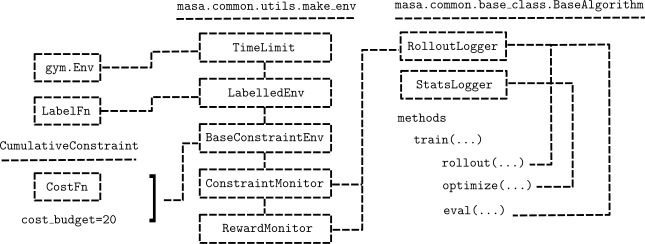
Overview of the abstraction stack used in MASA
Temporal Logic in MASA
Beyond scalar costs, MASA supports formal temporal specifications, including:
Safety LTL
“Something bad never happens.”
Bounded PCTL
“The probability of failure within
Tsteps is at mostp.”
These specifications are compiled into monitors that:
evolve alongside the environment,
emit costs and metrics,
integrate seamlessly with RL training loops.
Next Steps
Labelling Function - Learn how observation labelling is handled in MASA.
Cost Function - Understand the conventions used for cost functions in MASA.
Constraints - How are different constraints handled in MASA?
Wrappers - How do environment Wrappers provide a convenient interface for managing constraints?