Constraints Tour
This tutorial compares MASA’s registered single-agent constraints on the same environment and action scripts. The point is not to train an agent; it is to see how the same labels can produce different safety metrics.
Runnable notebook: notebooks/tutorials/04_constraints_tour.ipynb
Setup
Use CPU-first setup before importing MASA/JAX modules:
import os

os.environ.setdefault("JAX_PLATFORMS", "cpu")
os.environ.setdefault("TF_CPP_MIN_LOG_LEVEL", "2")
Import the shared environment, the central factory, and the small LTL helpers:
from pprint import pprint

from masa.plugins.helpers import load_plugins
from masa.common.ltl import Atom, DFA
from masa.common.utils import make_env
from masa.envs.tabular.colour_grid_world import cost_fn, label_fn

load_plugins()
Visual Overview
The notebook draws these diagrams with small helper functions. The static docs use matching rendered SVG assets, so the page stays readable without exposing the drawing code.
Seeded Trace Maps
Unsafe script:
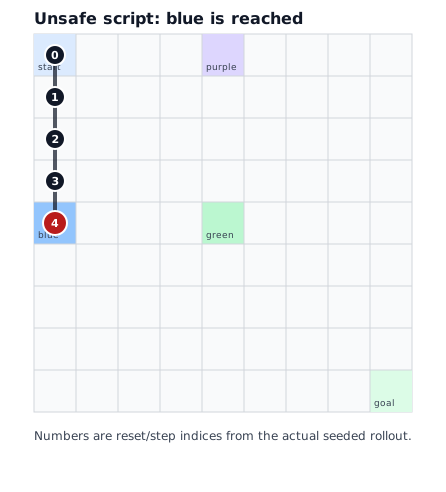
Seed 1 with actions [2, 2, 2, 2] reaches blue.
Goal script:
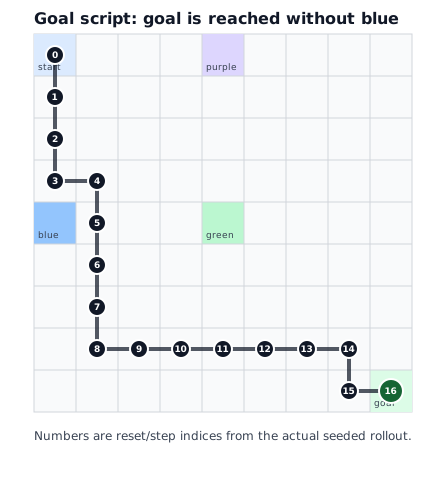
Seed 4 with actions [2] * 8 + [1] * 8 reaches goal without visiting blue.
CMDP and Probabilistic Safety
cmdp and prob both start from the same label-derived unsafe signal. They differ in how they aggregate it over an episode.
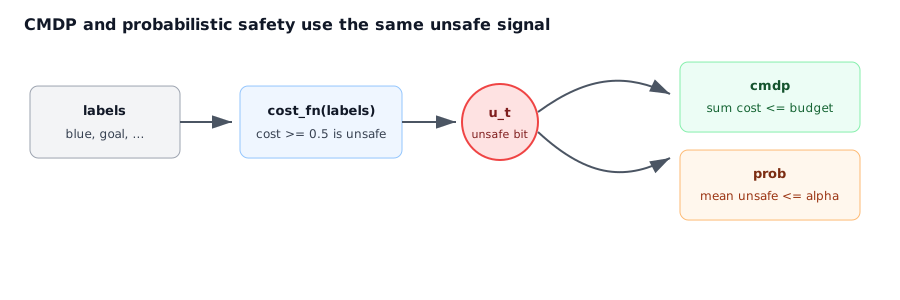
cmdp checks accumulated cost against a budget, while prob checks the fraction of unsafe steps against alpha.
Constraint Semantics
The same labels are fed to every constraint. The difference is the safety state each constraint derives from those labels.
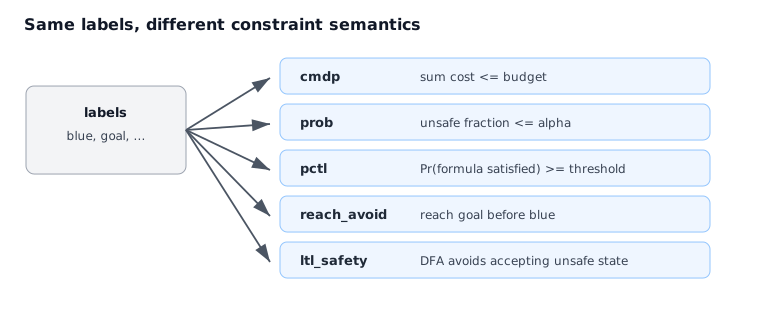
cmdp, prob, pctl, reach_avoid, and ltl_safety interpret the shared labels differently.
Build Each Constraint
The base environment and labels stay fixed. Only the constraint wrapper and its configuration change.
CONSTRAINT_NAMES = ["cmdp", "prob", "pctl", "reach_avoid", "ltl_safety"]

def build_constraint_env(name, max_episode_steps=40):
    if name == "cmdp":
        return make_env(
            "colour_grid_world",
            "cmdp",
            max_episode_steps,
            label_fn=label_fn,
            cost_fn=cost_fn,
            budget=0.0,
        )
    if name == "prob":
        return make_env(
            "colour_grid_world",
            "prob",
            max_episode_steps,
            label_fn=label_fn,
            cost_fn=cost_fn,
            alpha=0.1,
        )
    if name == "pctl":
        return make_env(
            "colour_grid_world",
            "pctl",
            max_episode_steps,
            label_fn=label_fn,
            cost_fn=cost_fn,
            alpha=0.01,
        )
    if name == "reach_avoid":
        return make_env(
            "colour_grid_world",
            "reach_avoid",
            max_episode_steps,
            label_fn=label_fn,
            avoid_label="blue",
            reach_label="goal",
        )
    if name == "ltl_safety":
        return make_env(
            "colour_grid_world",
            "ltl_safety",
            max_episode_steps,
            label_fn=label_fn,
            dfa=make_never_blue_dfa(),
            obs_type="dict",
        )
    raise ValueError(f"unknown constraint: {name}")
Run the Same Script Through Each Constraint
The helper below records the final row for each constraint. ltl_safety augments observations with automaton state, so the observation simplifier handles dictionaries as well as integers.
ACTION_NAMES = {0: "left", 1: "right", 2: "down", 3: "up", 4: "stay"}

def simplify_obs(obs):
    if isinstance(obs, dict):
        return {key: simplify_obs(value) for key, value in obs.items()}
    try:
        return int(obs)
    except (TypeError, ValueError):
        return obs

def run_constraint(name, *, seed, actions, max_episode_steps=40):
    env = build_constraint_env(name, max_episode_steps=max_episode_steps)
    obs, info = env.reset(seed=seed)
    rows = [
        {
            "event": "reset",
            "obs": simplify_obs(obs),
            "labels": sorted(info["labels"]),
            "constraint": info["constraint"],
            "automaton_state": info.get("automaton_state"),
        }
    ]

    for step, action in enumerate(actions, start=1):
        obs, reward, terminated, truncated, info = env.step(action)
        rows.append(
            {
                "event": f"step_{step}",
                "action": ACTION_NAMES[action],
                "obs": simplify_obs(obs),
                "reward": float(reward),
                "terminated": bool(terminated),
                "truncated": bool(truncated),
                "labels": sorted(info["labels"]),
                "constraint": info["constraint"],
                "automaton_state": info.get("automaton_state"),
            }
        )
        if terminated or truncated:
            break

    env.close()
    return rows

def final_metrics_for(script):
    return {
        name: run_constraint(name, seed=script["seed"], actions=script["actions"])[-1]
        for name in CONSTRAINT_NAMES
    }
Unsafe Script: Reach Blue
With seed 1, actions [2, 2, 2, 2] reach the blue state. Compare how each constraint reports the same labelled event.
unsafe_results = final_metrics_for(UNSAFE_SCRIPT)
pprint(unsafe_results)
Things to notice:
cmdpreportscost=1.0,violation=1.0, and cumulative cost above the zero budget.probreports an unsafe fraction abovealpha=0.1.pctlreports the PCTL-style condition as not satisfied for the unsafe trace.reach_avoidreportsviolated=True.ltl_safetymoves the DFA to the accepting unsafe state.
Goal Script: Reach Goal Without Blue
With seed 4, actions [2] * 8 + [1] * 8 reach the goal state without visiting blue.
goal_results = final_metrics_for(GOAL_SCRIPT)
pprint(goal_results)
Things to notice:
cost-based constraints remain satisfied because no blue state was visited,
reach_avoidis satisfied becausegoalwas reached beforeblue,ltl_safetyis satisfied because the never-blue DFA never entered its accepting unsafe state.
How to Read the Differences
cmdpaccumulates scalar cost and checks it against a budget.probtracks the empirical fraction of unsafe observations and checks it againstalpha.pctlis intended to evaluate whether a bounded PCTL formula’s satisfaction probability meets its threshold.reach_avoidseparately tracks whether the target was reached and whether the avoid label was ever seen.ltl_safetyadvances a DFA and reports violations when the automaton enters an accepting unsafe state.
The raw environment labels are the same. The constraint determines how those labels become safety state and metrics.